Outside · Harrison
Fall leaf walk “I spy”
On a quiet street near school or home, look for red leaves, crunchy piles, squirrels, and chimney smoke. Check them off as you go.
Builds visual scanning and noticing details.

A note from your OT
Hi, I am Andrea. I am your child’s occupational therapist at Purchase Elementary.
Are you a teacher? See For teachersNovember · Thanksgiving at home
School OT once or twice a week helps. Kids grow faster when that same skill shows up at home in small, ordinary moments. Pick one activity. Practice it in everyday life. That is where real change sticks.
Tap a tab, pick one idea, try it for a week.
Scroll for activitiesEach activity lists the grades it usually fits. Every child is different, so feel free to try activities from any grade.
Outside · Harrison
On a quiet street near school or home, look for red leaves, crunchy piles, squirrels, and chimney smoke. Check them off as you go.
Builds visual scanning and noticing details.
Fine motor
Tear brown paper bags or scrap paper into small pieces. Glue them into a round turkey body. Then tear orange, red, and yellow scraps for the feathers.
Hand strength and two hand teamwork. Tearing uses a pinch on both sides.
Scissors
Draw a few feather shapes with a curved edge on colored paper. Your child cuts them out, then snips little fringe cuts along the sides. Add them to the turkey.
Practices steering the scissors around curves.
Fine motor
Wrap a bit of tape around the end of a piece of yarn so it works like a needle. Thread O shaped cereal or pasta tubes, then tie it off. Skip this one if your child still mouths small things.
Finger control and eye hand coordination.
Writing
Write three things you are thankful for on lined paper, one per line. Younger kids can draw one thing and label it. Older kids can aim for even letters, spaces between words, and a period at the end.
Gives writing a real reason and a short goal.
Visual motor
Put a leaf under a sheet of paper, vein side up. Rub the side of a peeled crayon over it until the leaf shows. Make a page of different leaves and sort them by color.
Light, steady pressure and eye hand coordination.
Kitchen
Ask your child to set the table for dinner. Start with plates and forks. Add napkins, cups, and spoons as it gets easy. For a guide, trace a plate and a fork on a placemat.
Carrying, placing, and planning with a real job.
Two hands
Fold cloth or paper napkins into triangles, rectangles, or a simple fan. Press each fold flat with the palm.
Both hands work together and follow steps.
Kitchen
Let your child pinch salt or spices, scoop flour with a measuring cup, level it off with the back of a knife, and roll dough into balls. An adult handles the oven.
Pinch, scoop, and two hand work, plus waiting and following steps.
Movement
Strut across the room with big, slow steps. Flap your wings by squeezing your shoulder blades together behind you. Then balance on one foot like a turkey on a branch for five seconds.
Balance, posture, and shoulder strength.
Heavy work
Rake leaves with a kid size rake, help carry a bag of leaves to the curb, then jump into a pile. Check the pile for sticks first.
Whole body push and pull that can help kids settle and focus.
Balance
Put a crumpled paper “pie” on a paper plate. Carry it with both hands along a path around chairs and under a table without dropping it. Then try it with one hand.
Slow control, steady arms, and planning a path.
Gross motor
Toss soft balls or rolled socks into a laundry basket. Step back one foot each time you make it.
Eye hand coordination and body control.
Before homework
Stand an arm’s length from a wall with hands at shoulder height. Bend elbows to bring your chest toward the wall, push away, and repeat 8 to 10 times.
Gives shoulders and hands useful work before writing.
These optional free pages live on The OT Toolbox site. We do not host those files here. Some pages also offer extra packs for an email address. You can skip those.
Free ideas from trusted sources to practice thankfulness together this month.
Thank-you cards, a thankful tree, and a gratitude jar, with cutting, drawing, and writing built in.
A free bingo board where kids write, draw, or tell what they are thankful for. Great for younger kids.
Everyone at the table writes why they are thankful for the person next to them, then reads it out loud.
A gratitude tree, a family walk or backyard game, and a screen-free dinner table.
Seasonal outings close to home. Check each page for times and to register.
Rye · Saturdays in November. Nature Quest Nov 21 and Talkin’ Turkey Nov 28.
Free naturalist walks on the trails where kids hunt for clues, leaves, and turkey tracks.
Rye · Pumpkin Smash Nov 7 and Great Leaf Hunt Nov 14 (both free). Turkey Hike Nov 28 ($15 per family).
Messy, hands-on outdoor fun close to home.
Rye · Nov 14 and 15. Included with admission.
Indoor fall stations with leaf magnifiers, seed sorting, and cinnamon dough. Good for a rainy day.
Scarsdale · Dino Dig for ages 4 to 7 ($5). A bird walk Nov 7. A model train show on weekends starting Nov 14.
Dig for fossils with little brushes and scoops, great for busy hands.
Harrison · Fri Nov 20, 4:00 pm. Ages 5 and up.
Kids read out loud to a calm dog, which takes the pressure off for hesitant readers.
Valhalla · Thanksgiving morning, 8:45 am.
A short kids’ run before the big meal, and every finisher gets an award.
Yorktown Heights · Sat Nov 7, 10 am to 2 pm. Free.
Free hands-on activities at a working farm, a bit of a drive but worth it.
Plan practice around early dismissals, conferences, and breaks. Half days and vacation weeks still count.
Open full Harrison calendar
Download 2026 to 2027 one page PDF
Each activity lists the grades it usually fits. Every child is different, so feel free to try activities from any grade.
These are everyday ways to build the body skills behind handwriting. Use them when you have a few minutes at home. They work year round, not only in the fall.
Big body
Strong legs, core, and balance come first. Try hopscotch, catch, bike or scooter, jump rope, hula hoop, playground climbing, swinging, dancing, or a family sport.
Big muscles support posture and control at a desk.
Arms and shoulders
Wheelbarrow walks, crab or bear walks, work on the belly propped on elbows, tape a worksheet to the wall, write on a binder incline, erase a board, push a laundry basket, sweep, or do wall push ups.
Stable shoulders help the hand stay steady when writing.
Hands
Hide coins in PlayDoh and dig them out. Mystery bag (guess by feel). Stack blocks or Legos. Tweezers, clothespins, bead or Cheerio necklaces, coins in a bank, bubble wrap pops, stamps, or a simple tool set with screws and bolts.
Finger strength and precision for grasp and control.
Both sides
String beads, lace cards, fold laundry or paper, deal cards, cut shapes, tie shoes, catch and throw, or hand over hand tug games.
Kids need both hands for scissors, paper, and many school tools.
Eyes and hands
Puzzles, mazes, connect the dots, I Spy, Memory, pattern games, copying shapes in sand or shaving cream, MagnaDoodle, or cutting coupons and snowflakes.
Eye hand coordination for letters, lines, and copying from a board.
Family night
Operation, Connect 4, Jenga, Don’t Break the Ice, Ants in the Pants, Hi Ho Cherry O, Pick Up Sticks, Twister, Bingo, Chutes and Ladders, Memory, or a simple card game like Go Fish.
Turn taking, finger control, and attention without a worksheet.
Sensory
Put dry beans or rice in a shallow pan with measuring cups, spoons, and a few small toys or leaves. Scoop, pour, and hide things to find. Skip this one if your child still mouths small things.
Hand scooping, pouring, and calm focus.
Craft
Tear red, orange, and yellow tissue or scrap paper into small pieces. Glue them onto a big leaf shape you draw together. Hold the paper steady with one hand while the other hand tears.
Hand strength and two hand teamwork.
Fine motor
Draw circles on paper for faces. Peel stickers for eyes, noses, and silly mouths, then add marker details.
Peeling and placing work little fingers.
Hand control
Use child safe tweezers or tongs to move cotton balls or pom poms into a cup. Keep small items away from children who mouth them.
Practices a small, steady pinch.
Fasteners
Let your child button a shirt, coat, or pillowcase. Start with the bottom button and work up, then try unbuttoning.
Builds finger control for dressing and school tools.
Hand strength
Cut a slot in the lid of a clean container with adult help. Have your child pick up coins one at a time and push them through the slot.
Builds fingertip strength and careful release.
Fasteners
Poke holes in a piece of cardboard. Thread a shoelace in and out, then pull it snug. Slow down and name each step.
Builds two hand coordination for daily tasks.
Construction
Use scrap paper to make a simple folded fish, hat, or boat. Say your steps out loud and press each fold flat.
Uses two hands, motor planning, and precision.
Tool use
Use a safe household tool such as a screwdriver on a toy, a measuring cup, or clothespins. Follow safety rules and put tools away.
Builds controlled hand use for practical tasks.
Tool use
Cut, fold, and tape scrap cardboard into a small sign or stand. Measure with a ruler if you have one and test whether it stands.
Works on hand strength, precision, and problem solving.
Scissors practice
Give short strips of colored paper and child scissors. Make confetti for a collage.
Open and close practice before longer cutting tasks.
Scissors
Before cutting, check both thumbs. The cutting hand thumb is on top in the small hole. The helper hand holds the paper with its thumb up too.
Good hand position makes cutting easier and neater.
Curves
Draw a wide wavy road on scrap paper. Your child cuts down the middle and stays on the road. Make the road thinner as they get better.
Practices steering the scissors around curves.
Corners
Draw a big square or zigzag. Cut to a corner, stop, and turn the paper with the helper hand. Then keep cutting.
Teaches kids to move the paper, not their whole body.
Two hands
Draw a large circle. Keep the scissors pointing forward and have the helper hand slowly turn the paper while cutting. Say “turn, snip, turn, snip.”
Builds teamwork between the cutting hand and helper hand.
Visual motor
Draw a big sideways 8 on paper or a whiteboard. Have your child trace it with a finger, then a crayon, without lifting. Keep the head still and follow the line with the eyes.
Helps hands and eyes cross the middle of the body smoothly.
Fine motor
Put stickers or small toys on one side of your child. Have them reach across their body with the other hand to grab each one. Stick them on a paper on the far side.
Builds reaching across the body, which helps with writing and reading left to right.
Rhythm
Sit facing each other. Clap your own hands, then clap right hand to right hand, clap again, then left to left. Go slow, then speed up.
Practices both sides of the body working together.
Visual motor
Draw a simple map of one room. Have your child copy it, add a path from the door to a chair, and circle three objects.
Supports copying, spacing, and visual planning.
Visual motor
Make a repeating pattern with leaves, blocks, socks, or small toys. Have your child copy it and make one for you to continue.
Works on spacing, visual attention, and flexible thinking.
Visual planning
Draw a simple route from one room to another or around the block with an adult. Add landmarks and a start and finish.
Supports visual organization and planning.
Independence
Give your child a short list out loud: book, water bottle, and sweater. Let them find each item and pack it in order.
Builds sequencing and everyday responsibility.
Fasteners
Practice starting and pulling a zipper on a jacket or backpack. Ask your child to check that it is closed before moving on.
Supports dressing skills and self-checking.
Kitchen planning
Let your child choose a simple snack, name the steps, gather what is needed, prepare it safely, and wipe the work area when finished. Older kids can plan it with no reminders.
Builds planning, sequencing, and independence.
Organization
Empty a backpack together. Make three piles: keep, take home, and recycle. Pack the items needed for tomorrow.
Supports sorting, routines, and school readiness.
Household skills
Carry a small basket of laundry across the room. Match socks, fold shirts, and sort clothes by person or drawer. Let your child choose the order of the steps.
Heavy work, two hand coordination, and organization.
Organization
Use a spoken checklist or make one on scrap paper. Pack school materials, check the weather, and choose clothing before bedtime.
Builds routines, sequencing, and self-management.
Time and planning
Choose a chore or homework task. Name the first three steps, estimate the time, and check each step as it is finished.
Supports starting, sequencing, and flexible planning.
Independence
Have your child choose a simple breakfast, gather what is needed, prepare it safely, and clean the space without step by step reminders.
Practices planning and follow-through.
Movement
Choose three moves such as ten wall pushes, five frog jumps, and a slow tiptoe across the room. Repeat once.
Wakes up the body before a seated task.
Focus break
Choose a two minute movement break such as wall pushes, a walk, or slow stretches. Return to the table and name the first task.
Helps practice shifting from movement to focused work.
Regulation
Choose three steps for a reset, such as water, slow breaths, and a short walk. Practice the routine before the next seated task.
Gives your child a repeatable way to get ready to focus.
Movement
Choose one push, one balance move, and one jump. Write the order on scrap paper, complete two rounds, and change one part.
Combines motor planning, control, and flexible thinking.
Many kids need practice into early elementary. Start with the shoe on a table or lap, not on the foot. Use two different colored laces or pipe cleaners so loops hold shape. Pick one method and stick with it. Short daily practice beats long frustrated sessions.
Make it easier to see
Use two different colored laces or pipe cleaners so your child can see which loop and end to move next.
Start off the foot
Keep the shoe still and visible on a table or lap before trying the same steps while wearing it.
Try one way
Pick one method and stick with it for a while. If one loop is hard, try bunny ears, or the other way around.
Build independence
Start most of the steps for your child. Let them finish the last pull, then add one earlier step at a time.
Videos are third-party. Choose what fits your child.
Each activity lists the grades it usually fits. Every child is different, so feel free to try activities from any grade.
Kids learn to copy shapes in this order: line, circle, cross, square, triangle. Start with the first shape your child finds tricky. Letters use these same lines and curves, so shapes come first.
Pencil control
Draw big dots on a paper plate or napkin and have your child connect them slowly.
Steady hands before formal worksheets.
Sensory writing
Spread salt or shaving cream on a tray or baking sheet. Draw a shape or letter with your finger and have your child copy it below yours. Shake or smooth the tray to erase and try again.
Feeling the shape makes it easier to remember.
Build it
Use craft sticks, straws, or pretzel sticks for lines, crosses, squares, and triangles. Roll playdough into snakes for circles and curves. Then build a letter together, like L, T, or O.
Kids see how shapes and letters are put together.
Big to small
Stand up and write a shape or letter in the air with a straight arm, big and slow. Next write it on the table with one finger. Then write it tiny on your palm.
Big moves help the body learn the path before using a pencil.
Paper
Draw a shape or letter and put a dot where it starts. Draw a matching dot for your child to start from. Remind them that most letters start at the top.
A clear starting point helps letters come out the same way each time.
Many kids mix up letters like b and d until second grade or later. This is common. This chart shows the letters and numbers kids flip most often: a, b, d, g, j, p, q and 1 to 9. Each one has arrows and a picture cue.
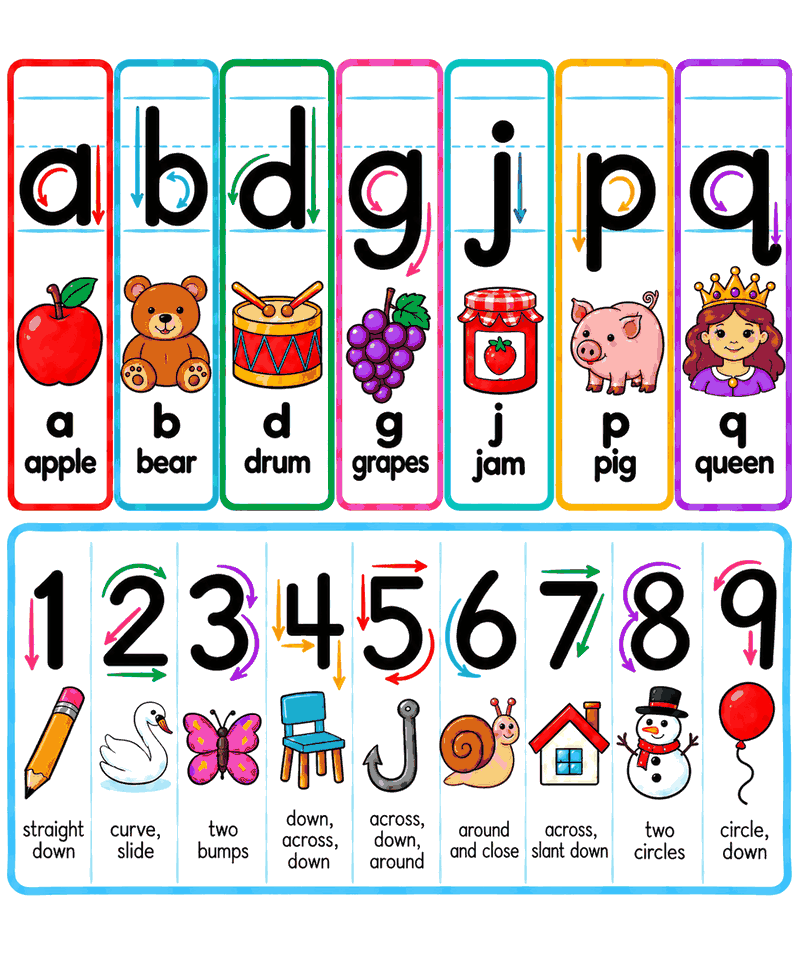
How to use the chart
b and d
Make two thumbs up fists with knuckles facing each other. Your hands look like the word “bed.” The left hand is b and the right hand is d.
Gives kids a quick check they always have with them.
Letter starts
Most letters and numbers start at the top. Before writing, ask “Where do you start?” and point to the top line. Use the arrow on the chart if they are not sure.
Starting in the same place each time helps stop flips.
Visual game
Write a row of mixed letters, like b d b p d q b. Your child circles every b with one color, then every d with another. Try it with a page from a magazine or cereal box.
Trains the eyes to notice small differences.
Some kids press very hard. You may see dark lines, holes in the paper, broken pencil tips, or a tired hand. Other kids press very lightly. Their writing looks faint and hard to read. Both can make writing slow and tiring. These games help kids feel the difference.
Feedback
Put paper on top of a mousepad, foam sheet, or folded towel. If your child presses too hard, the pencil pokes through. Try to write without making holes.
Kids can feel when they are pressing too hard.
Game
Trace a line or letter two ways. First “light as a feather,” so it barely shows. Then “strong as a tiger,” dark and bold. Then find the middle “just right” way.
Teaches kids to change how hard they press.
Challenge
Write a short sentence with a mechanical pencil. If the lead snaps, press a little softer. Count how many words you can write without a break.
A fun way to practice gentle, steady pressure.
Warm up
Before writing, squeeze playdough, push palms together hard for five seconds, or do wall pushes. Then shake the hands out.
Wakes up hand muscles so kids can control their pressure better.
Writing
Ask your child to draw and label three foods for a pretend cafe. Add a price or a star beside a favorite.
Short writing practice with a real purpose.
Writing
Fold a strip of paper and write a favorite book title, a short recommendation, and your name. Add a border or pattern.
Builds writing stamina and control in a useful project.
Handwriting
Write or copy four short recipe steps on an index card or scrap paper. Leave spaces between steps and add one small drawing.
Practices legibility, spacing, and writing endurance.
Writing stamina
Write a short thank-you, reminder, joke, or invitation for someone at home. Focus on a comfortable grip, clear letters, spaces between words, and punctuation.
Keeps handwriting connected to real communication.
It works like the zipper check. Kids finish the job, then check it before moving on.
Self-check
Pick one question from the list for the week. After homework, your child checks only that one thing and fixes it. Add another question when it gets easy.
Small steps build the habit without making homework longer.
Self-check
Have your child read their sentence out loud and go down the list. They give a thumbs up for each yes. If something is missing, they fix it and check again.
Kids learn to catch their own mistakes.
Keyboard
Put fingers on the home row: a s d f and j k l ;. Bumps on f and j help find home without looking. Call out a letter and your child presses it with the right finger, then returns home.
Builds touch typing so eyes can stay on the screen.
Practice
Short daily practice works better than one long session. Use one of the free sites below for about ten minutes. Focus on correct fingers before speed.
Steady practice builds typing speed over time.
Tech tool
Most computers and tablets have built-in voice typing. Have your child say a sentence and watch it appear. Then read it back and fix any mistakes.
Helpful when ideas come faster than hands can write.
Free step-by-step typing lessons for kids.
A fun typing game for beginners.
Free lessons and games to practice typing.
How to type with your voice in Google Docs.
How to turn on and use dictation on a Mac.
How to dictate text on an iPhone.
How to use voice typing on a Windows PC.
Thanksgiving can mean a full house, loud voices, strong smells, and food your child does not know. A little planning helps many kids. Pick the ideas that fit your family.
Before you go
Tell your child who will be there before you arrive. Come early if you can, while the house is quieter, so they can look around first. A wave, a fist bump, or a high five works as a hello instead of a hug.
Sound
Bring headphones or earmuffs and let your child decide when to use them. Plan a break from the noise, like a walk outside, a book, or a quiet show in another room.
At the table
Bring one food your child knows they like. Put a very small bite of something new near the plate, with no need to eat it. Touching, smelling, or just sitting nearby counts. Skip comments about what they do or do not eat.
Reset
Pick a calm place before the meal, like a bedroom or a corner with a blanket. Add a book, a fidget, or headphones. Tell your child they can go there any time, no questions asked. A few jumps or wall push-ups first can help too.
Plan
Make a short list or picture schedule: car ride, say hello, play, dinner, dessert, go home. Give a five minute warning before big changes, like sitting down to eat.
On the road
Pack a small bag with snacks, water, a fidget, headphones, and a favorite toy. Plan stops to stretch and move on long drives. Let your child carry their own bag. Carrying something heavy can feel calming.
Before and during the meal ideas, and why sitting at the table can count as success.
Headphones, a calm corner, movement breaks, and a snack pack of safe foods.
A pediatric OT guide to small portions, divided plates, and low pressure tasting.
These ideas are for fun and learning at home. They are not medical advice.
Our bodies give us clues all day. A fast heart, a tight tummy, or hot cheeks can show up before a big feeling does. These games help kids notice those clues early, so they can ask for help or take a break sooner.
Check in
Have your child lie down and close their eyes. Name one body part at a time, from toes to head, and ask "What do you notice there?" Any answer is fine, even "nothing."
Kids practice paying attention to the inside of their body.
Heart
Have your child place a hand on their chest while sitting still. Then do 20 jumping jacks and check again. Talk about fast and slow.
Kids learn that a fast heart can come from moving or from big feelings.
Words
Pick words for how the body feels: slow, just right, or fast, like a car engine. Check in a few times a day, like after school or before bed. Grown-ups can share theirs too.
Simple words make it easier to say what is going on inside.
Skin
Let your child hold their hands under cool water, then warm water. Ask where they feel it and which one they like. Try a cold apple and a warm mug of cider too.
Noticing temperature builds awareness of skin signals.
Hunger and thirst
Before a snack, ask "Is your tummy empty, a little hungry, or full?" Ask again after eating. Do the same with thirst after playing outside.
Kids learn to notice hunger, fullness, and thirst cues.
Muscles
Have your child squeeze their whole body stiff like a statue for 5 seconds. Then flop like cooked spaghetti. Ask how each one felt.
Kids learn what tight muscles feel like, which often happens with worry or anger.
Breathing
Breathe in slowly to "smell the apple pie." Breathe out slowly to "cool the pie." Have them notice their belly rise and fall.
Slow breaths give kids a tool they can feel working.
Feelings
Trace your child's body on a big paper bag or draw a gingerbread shape. Ask where they feel mad, happy, or scared, and let them color those spots. There are no wrong answers.
Kids connect feelings to real places in their body.
A plain overview of the "eighth sense" and how it affects kids.
What interoception is and ideas to build it at home.
A children's hospital guide with easy ways to talk about body signals.
These ideas are for fun and learning at home. They are not medical advice.
Sensory friendly usually means lights a little brighter, sound a little softer, and smaller crowds. Kids can move, talk, or step out when they need to, and there is often a quiet space or a kit with headphones. Dates and details change, so check each page before you go.
Monthly sensory friendly movies, usually the first Sunday. Lights up, sound down, captions, no trailers, and kids can move and talk.
Family showings on the second and fourth Saturday of each month. Lights up, sound down, no trailers.
Free backpack to borrow with headphones, fidgets, sunglasses, and a weighted neck wrap. Quieter times are usually weekdays 2 to 5 pm.
Sensory map, free earplugs, and a calm room. Quieter on weekdays after 1 pm.
Free Early Morning Openings for kids with autism or sensory needs before the museum opens, with a sensory bag. Next listed: Nov 7, 2026. Register ahead.
Sensory bags at every entrance, a quiet sensory room, and a sensory map of loud and calm areas.
Free sensory kits with headphones, a sand timer, and fidgets. Best for ages 0 to 6.
General ideas for families from occupational therapy sources. These are not a substitute for your child’s plan.
Simple plans for busy, noisy gatherings, like a quiet break spot and a signal to use with your child.
Easy ways to build thankfulness all year, including other ways to say thanks when writing or talking is hard.
A short video that pairs a calm-down breath with using the five senses to notice what you are thankful for.
Research and articles for interested parents.
Many kids’ hand skills are behind what we used to see, especially when play is less active.
A longer free read on the same idea: hand skills and how kids move day to day.
Outside play can help balance things when kids also spend time on screens.
Playing outside in nature often goes with stronger movement skills.
Practical tips for building self-control in grade-school kids.
Simple ways to practice waiting, calming, and flexible thinking at home.
These are free online sources for curious parents. They are not medical advice for your child.